Saturday, June 19, 2010

Garden Post #2

I am usually a restless fidgety sort of person. It's in my genes. My father is that way as well. I am quite surprised by how much I enjoy sitting in my garden, just sitting there contently doing nothing, like a dog or cat just sitting... happily. Unlike a dog, I usually keep my tongue in my mouth while I'm sitting there.

I occasionally get up to sweep some of the junk the dogwood tree is constantly dropping into the mulched areas. Sometimes I'll pretend to read a book, but for most part I just sit contentedly.

This picture of the back seating area is about a month and half old. The hydrangea behind the chairs is much larger now. The hostas have really taken off as well.

I added this seating area in April. It's connected to the first seating area on the other side of the dogwood tree. Most of the day, it's a nice shady spot. Various species of birds can usually be heard singing; squirrels do weird shit. It's extremely peaceful.

This seating area, which quickly became my favorite, is as far from the house as possible. While sitting there, it occurred to me that is area is contrary to what has been the modern outside seating arrangement for the last 50 years, which is a deck or concrete slab immediately off the back of the house that looks out onto a sea of grass. Sooner or later, I intend to have a porch built on the back of the house; I suspect this spot will remain my favorite sitting spot. We shall see.

Sunday, May 9, 2010

Garden Post #1

One of the things I most love about being in my 40s is my garden. I bought my middle-aged man house when I turned 40 in 2005. I worked on the 100+ year old house for two years before we moved in.

The yard was a project that had to sit on the back burner. That gave me several years to plan and several years of being a little frustrated at the unrealized potential. Last year, 2009, I finally got the chance to work on it properly. It has become my personal green oasis and I do my best to spend at least a little time sitting in it every day.


Rather do a very long post on the garden, I'm going to do a series of shorter posts about various aspects of it. Gardening is definitely a middle-aged thing, so it fits right into this blog. Today's post is the intro to the series and a quick before and now comparison. This post is a bit dry and boring. I think they will get better after this intro one.

The top picture captures the back 2/3s of my yard as of May 2010. My yard is a big one for the city, measuring 25 by 64 feet (I know because I plotted out on a grid last spring before beginning work). Things are green but the growing season is only just beginning.

Here's what it looked like in 2005 when I bought the house. Here's the same angle today (more or less). I have been converting it from underused space that required weekly mowing to a very utilized space that requires little work to maintain.


Saturday, May 8, 2010

Reading the Dame Part 2A: The first half of the 1930s

Reading the Dame Part 2A: The first half of the 1930s

In a prior post, I wrote about my project to read/re-read all of Agatha Christie's mystery books in order (I think I can pass on her pseudonLinkymous Mary Westcott romances; there's enough romance in the Agatha Christie mysteries. Also after I finish about 80 full length Agatha Christie books, I'll need a long break from her).

While Agatha Christie could weave a very tightly plotted tale, it's becoming clear she wasn't a really truly great writer. She doesn't stick with you like Hemingway does (kind of like a rash), or sneak up on you like Twain, or just frigging rule like Steinbeck (man, that guy could write). She's clear and concise and extremely readable, but her writing is somewhat stiff. There is no real voice there and her writing is devoid of humor. Maybe it was her upper crust English breeding, though Aldous Huxley definitely wrote with what could be called a voice. The words do not dance nor sing; the characters rarely linger in your memory. I don't want to imply that she was a bad writer, she indeed was a quite good writer; just not great. This lack of greatness is probably how she was able to kick out so many books.


OK, onto the books. She published 9 books between 1930 to 1935. As before, some of the comments are about the book, some about me reading it when I was younger and re-reading it now as a forty-something guy, some are about 20th century fiction reread from a 21st Century viewpoint. Some are completely pointless.


(1930) The Murder at the Vicarage
Christie's 1930s output starts off with The Murder at the Vicarage. This book marks Miss Marple's first appearance. For those who don't know, she's a spinster from a small village. Her deal is that you can learn about people without being well traveled by observing village life. This knowledge can be used to solve mysteries.
Tuppence of the Tommy and Tuppence books was the daughter of a vicar. The difficulties of a vicar's household keeping servants due to not being able to offer a competitive wage is revisited here. While most of the book is set in a vicarage, quite a bit of it happens at a country estate.

Another really solid effort with a tightly woven plot. I read this one before, sometime in the 1980s. I forgot enough to not remember who done it.


(1930) The Mysterious Mr. Quin
Next up was a collection of short stories, The Mysterious Mr. Quin. This is an unusual book as it features the quite mysterious Mr. Quin, who appears time and again in Mr. Satterthwaite's life. Quin, is Mr. Harley Quin, aka Harlequin. I have any a passing familiarity with the 5 or 6 historic stock classic clown characters of which Harlequin is one. I don't want to know either. I could very well look it up, but clowns are creepy.
I had read this one years before when I was in my teens and it quite stuck with me. Way back I read that Kevin Smith (aka Silent Bob) named his daughter Harley Quinn. While he most definitely named her after a comic book character, I immediately thought of this book.

In each story, Saiterthwaite stumbles on a mystery and Quin shows up at the right moment to guide Saiterthwaite to the solution. When I was younger the mysterious Mr. Quin, who acted all mysterious and seemed to know all, was quite cool in a Racer X sort of way. Now I believe that a Harlequin is some sort of clown and I'm a little creeped out. Now that I'm older, Satterthwaite is the more curious character. He is an quite rich old bachelor who is more like a busybody old maid. He travels in the richest circles, and he also travels in the artistic circles as a patron of the arts. Satterthwaitte isn't as douchey as you might expect, but he's not especially likable either. He seems like the character Christie was destined to create. He has reappeared in a book in reading right now, but that will have to wait until the next installment of this series.

Saitterthwaite gets a back story. He was going to propose to a girl at Kew Gardens, but instead she tells him about another guy she's crazy about. He then spends the rest of his life as a bachelor. This makes the lack of backstory on Poirot after numerous books even more curious.
Satterthwaite's typical year is described as being in London for the social season, going to the Riviera in the winter, coming back to London briefly before making a tour as a guest at various country homes. He also would spend a few weeks in Scotland every year (doing what isn't explained). Satterthwaite has a Rolls Royce and a chauffeur to drive him in it. Which gets me thinking of the logistics and economics of the whole thing. Is the chauffeur on salary year round, or only during the driving through the country house visiting season? My guess is the chauffeur would get a day rate and has to fend for himself during the winter. Satterthwaite gets his own room (sometimes a suite) when he visits the various country estates. I guess those "great houses" must also have had spare servants rooms for servants who came with the guests. So if Satterthwaite stays a week before moving on, what does his chauffeur do during that time (and is he still getting the same day rate)? I image some of the time is spent cleaning and polishing the car, but that's probably only an hour a day. What about the rest of the waking day? Spent it at the village pub or playing cards with the other servants? After the Agatha Christie reading project is done in a few years, I'll have to find a book written from the perspective of the servants.

The perspective of the leisure class in the travels is interesting in a how the other 1/2 of 1% lives sort of way.

This was a good read, but I liked better my first time around. I lived too much to be particularly sympathetic to the leisure class.


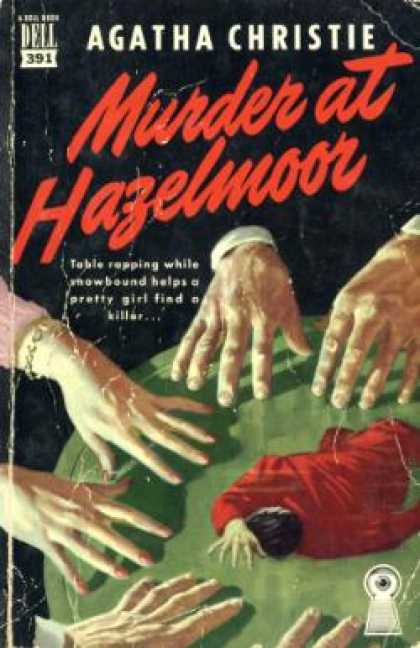
(1931) Murder at Hazelmoor (also known as The Sittaford Mystery)
A little ways in I realized I had read this one before. I definitley didn't remember who did it. Towards the end of the book, there was a clue that struck up a lost memory. I remembered who and how. Or maybe I just figured it out with my brilliance. You probably suspect the former, but we'll never know.

Hazelmoor is yet another really good read. Lots of interesting characters and some interesting plot twists. While the murder happens at a named country house, at bit of action also takes place at a pub, which was quite interesting to me being a publican.

Once each in several of her books, Christies uses the verb "vouchesafed", which appears to be a synonym for "said". I remember this word from reading Christie as a teen. It was a new word to me. It didn't take much contemplation to back then decide it was a word that I didn't need to add to my vocabulary. Agatha Christie books are the only place I have ever seen the word vouchesafed. It made an impression on me, but I totally forgot about it until stumbling on it again (and again) as part of this reading/re-reading project. I never looked up the exact meaning of vouchsafe, but now that I'm typing this on a computer with access to the Web, there's no reason not to. Here's the definition, "grant in a condescending manner".

I rip on Christie's writing ability in the second paragraph above, but I really liked this one. This one has stick-to-you-ness.


(1932) Peril at End House

For some reason Hastings is back in England and taking a week long beach holiday with Poirot. No reason is given why Hastings is no hurry to get back to his ranch and his wife in Argentina.

Drugs, cocaine specifically, play a role in this mystery, which once again happens in a country manor house, though one that has seen better days.

At some point I got into the habit of writing the month and year I read a book on the inside cover.
I read this one before, the note in front says "08/81", just about some 29 years ago. Wow crazy, so long ago. Even without looking for my notation in the book, from the title I remembered reading this one before. Strangely I remembered pretty much none of the story. Or maybe not so strangely as it has been 29 years. So I had read all her books from the 1920s before, except one. And so far I had previously read all 4 books of the 1930s that I have gotten up to. Before this project I was under the impression I had only read about 50%, maybe 60%, of Christie's 80 or so books. For Christie books published between 1920 and 1932, I'm running about 95% previously read.

This was another really good read. As usual the plot is well constructed. As usual Christie does a great job of parceling out clues and the surprise ending doesn't feel like a cheat.


(1932) The Thirteen Problems (aka The Tuesday Club Murders).

This is a bunch of Miss Marple short stories, interwoven into a novel, an old Christie trick that always worked well. The old bat solves them all. I think I partially read this one before, though it must have been a library book. I probably returned it without finishing it, maybe starting it on a school break.

It was a good read, but I found myself pondering the Miss in Miss Marple. I recall being a lad in the 1970s; for some reason my mother's side of the family seemed to know a lot about proper salutations and whatnot. Maybe that was taught in secretary school and most women knew it then. Unmarried women were Miss and married women were Mrs. Married or umarried, men over 13 were Mr. I recall being a Master until 13 when I became a Mr. Until then birthday cards from my Aunt and Nana were addressed to me Master.

I also recall sometime in my childhood Ms., pronounced "mizz" and which I had thought was spelled "Mizz", became newsworthy. It was explained to me that Mizz was for addressing both married and unmarried women, but why anyone who want to do that was unknown... some sort of women's lib thing. Looking back on that now, that must of been when the New York Times switched to Ms. from Mrs. and Miss, making Ms. newsworthy. Looking back now, I can see how that would have been big news. I like that here in the 21st century, the NYT still refers to everyone Mr. and Ms. As crazy as it would seem today to make a distinction between a woman's martial status, when the same isn't done for men, I can't see Miss Marple ever being a Mizz Marple. And you'd never dare call her Jane.


(1933) Lord Edgware Dies (aka Thirteen at Dinner)

I recalled reading this one (and a note in front said I read it December 1993) but I had little memory of it, so the ending wound up being a surprise. I have gotten pretty good at solving the mystery before the reveal, but Christie got me here.

Actors have made appearances as character in several books so far. In this one, the actors are mostly movie actors. At this point talkies have been around for a few years.

Another strong read, which percolates nicely and has a satisfying conclusion.

Several curious things here, Hastings again is the narrator,
back in England and staying at Poirot's. Having seemingly taken up lodging there. No mention is made of Hastings wife nor his life in "the Argentine", though he does get suddenly recalled to the Argentine just before the last chapter. Still no backstory on Poirot.

The other curious thing is that Poirot, makes a mention of spending an afternoon involved in a case involving an ambassador's boots and cocaine smuggling. I went back and looked, and that was a Tommy and Tuppence case from Partners in Crime, which was published about 4 years earlier. Poirot does not appear in the published story. Did Christie get her detectives mixed up? Or maybe Poirot heard the story while hanging out at Scotland Yard.


(1934) Murder on the Orient Express.

This is one I hadn't read before. But I do recall watching the movie on video and finding it a little dull. Even worse I remembered whodunnit. It is one of those where you don't forget it.

This seems to only be the 2nd book so far that I hadn't read before. Curiously the other one, The Mystery of the Blue Train, also took place on a train. So that's 19 out 21 books so far that I had already read before.

I have been collecting books since I was teenager with the aim of eventually having a book lined study when I was adult. Many of the books were picked up used at flea markets or thrift stores, so I have little idea where (or when) most of the books came from. In the back of this book I found a bit of an envelope seemingly used as a book mark. It was addressed to Master Jeffrey Riley of Andalusia PA. So my brother and I weren't the only two boys getting mail addressed to us as "master". The post mark is from the 1970s. It's curious how "master" reappears after my thoughts on that word a couple books up.

The remembrance of the book lined study idea takes me back to a memory from college. For some reason I was in the office of one of my Philosophy teachers. His office had hundreds of books on wall mounted book shelves. He saw me observing that and asked if I was impressed by the number of books. I was actually impressed that he got the college to put up that many book shelves for him. I was 19 and been buying books for years at that point. Quantity of books didn't impress me as I knew how inexpensive it could be to amass quite a few. I did know what an ordeal it was to get anything accomplished at La Salle University (great faculty, but the non-teaching staff was terrible), so I was way more impressed with the book shelves. Rather than express all that, I just said "yes".

Once I got my own house, I discovered reading a book in a book lined room wasn't as romantic as it sounded, not in the least. Maureen and I have quite a collection of books. Technology has really changed everything, or almost everything. Turns out for me the content is more important than the physical object. Like music, I'd rather have them all in electronic form, but that getting them that way would cost way more than owning printed copies nobody much wants. Unlike CDs, books aren't easily rippable, so unlike our large collection of CDs, which will probably go away at some point, like vinyl albums and cassette tapes, our books will probably continue to take up space in our home for quite a while.

So onto the book. It was a very good read despite knowing whodunnit. I liked it. Unlike the movie, it was never dull.

Still no back story on Poirot, who winds up on the Orient Express after getting called back early from Istanbul, here called Stambul for some reason.

In Europe, Pullman (sleeper) cars were called Wagons-Lits. In the USA, the Pullman Company out of Chicago, built and operated the sleeper cars. They had some sort of deal with the railroads to attach the sleeper cars to the trains. Compagnie Internationale des Wagons-Lits was the European copy.

(1934) Mr Parker Pyne Detective
I read this one before too. Mr. Parker Pyne is a retired government statistician who opens a business to help unhappy people. This one too is a collection of related short stories. It was a good read the second time around too.

Mr. PP is famous for his daily front page ad in the newpaper inviting unhappy people to visit his office, where he will solve their problems. This got me to thinking about the death of newspapers. Once they were the only means to reach the masses. News, classified ads for jobs or apartments or stuff, entertainment, ads for services, it was all there. The service ads were published daily waiting for someone to need a lawyer, doctor, plumber, whatever. All of those things were gradually usurped by other media.

This book had a real potential to be terribly dated with sexism and racism. Happy it isn't.

Parker Pyne winds up on vacation for the stories at the end of the book, where he winds up on the Orient Express. She got some mileage from that train trip.

(1934) Why Didn't They Ask Evans
I read this one before too. It features two somewhat young people in their mid 20s. One a titled daughter of a very rich man, the other a penniless 4th son of a country vicar who was aimless after leaving the military.

The heroine is a rehash of Bundle, Lady Whatever of Seven Dials Mystery and The Secret of Chimneys. She too is rich, titled due to the death of her mother, independent, doesn't work, and lives with her widower father. This reads like a Tommy and Tuppance book, which isn't a bad thing.

For one part, the vicar's son poses as her chauffeur. While the lady is staying at the country estate, the chauffeur stays at the local pub. His only duties are to be near the phone in case the lady wanted to be driven somewhere. So that answers the chauffeur mystery from The Mysterious Mr. Quin.

Plenty of twists and turns in the plot. A great read. Of course rich chick settles down with poor boy. I liked this one, but it left me a little cold.


I have 13 more books to read to get from 1935 to 39. I have two down. Next installment will be in a few months.

Saturday, February 6, 2010

Reading/Re-Reading the Dame: Part 1 - The 1920s

Reading/Re-Reading the Dame: Part 1 - The 1920s
In 1976, many of Dame Agatha Christie's 79 books were reissued in paperback after her death renewed interest in her. That was just about when I started reading from the adult section of the library. As a result her books were readily available and easy to find there, so I ended up reading a lot of Agatha Christie books as a teenager. I continued to read them on and off (mostly off) in the following years.

Last summer I decided to read all 79 Agatha Christie books in order of publication. This will be a multi-year project. I just finished the 12 books she published in the 1920s, which are about a 50/50 mix between novels and short story collections. It took me 5 months to read those 12. Quite a few of the books I collected cheaply over the decades from used book shops, thrift stores, yard sales, etc. The rest, one decade at a time, I have been buying used from Amazon for about $4 including shipping.

19 Random Thoughts
Here are some random thoughts. Some are about Agatha Christie. Some are about my experiences reading her first as a teen and now as a middle-aged man. I bolded them a little bit to hopefully make the whole mess a little more readable.

1) What strikes me now as a person of 44 years living in 2010 is how incredibly snobby the books are. Thanks to the modern wonder of the Web, I now know that Dame Agatha was the daughter of a rich American father (of the New York Piedmont Morgans) and an English mother. She was born upper class and definitely had an opinion of the lower class. All of the characters so far have been "gentlefolk" like her. Inheriting money or marrying into it being much more acceptable than actually earning it. With the exception of butlers and housekeepers (which are different from maids), the servants are almost always totally undeveloped as characters.

2) Regarding butlers, it is as though the Merchant Ivory movie The Remains of the Day (which is based on a novel by by Japanese-British author Kazuo Ishiguro) is based on the butler character in The Secret of Chimneys, who reappears in the The Seven Dials Mystery. The perfect butler is a gentleman's gentleman, who never shows emotion, yada yada. I had rewatched The Remains of the Day a little before rereading Seven Dials and Chimneys, so the similarities were really evident to me. You have to wonder if Ishiguro has read The Secret of Chimneys, and/or the wonder of the perfect English butler is just common fodder.
3) Thinking back, maybe even as a teen I was aware of the snobby tone, but didn't mind it. At Father Judge High School, the Oblates tried to mold us into young gentlemen. And I bought into the gentleman thing. As a teen I thought maybe I could join the rich club someday (which seems like such an unChristian thing to do). Totally like James Mason. In my years since I've mingled with the old money rich a tiny bit and I know it's a club I don't belong in, even if I had some money. I'm whitetrash from Northeast Philly. But I've very cool with that. I'd rather be that than snobby.

4) I suspect I probably wouldn't have liked Agatha Christie as a person.

5) Some of the things she writes would have made me a socialist if I was living in 1920s England. The rich never once pondered that maybe their accident of birth resulting in their much better and totally unearned lifestyle just might be rather unjust. They considered themselves heroic in being poor while waiting for a rich relation to kack and leave them their wholly deserved inheritance. The short story collection The Golden Ball is especially appalling from that perceptive. Many times in her 1920s writings she describes servants actions as being typical of their class.


6) Selected The Golden Ball story number 1: a daydreaming office worker wins a contest and buys an expensive car, which he keeps secret from his sensible fiancee. Due to a misunderstanding (apparently cars didn't need keys back then). He gets mixed with up a group of young rich people ("The Pretty Things" - coincidentally I had a little while before watched the movie Pretty Young Things, which is about young rich English society people in the 1920s). He of course has to return to his own class after the adventure is over, but he had the joy and honor of seeing the other side briefly.

7) Selected The Golden Ball story number 2: a spoiled young man lives with his rich uncle and works for the uncle. After being hung over and late to work yet again due to staying out late with other young upper class London socialites, the uncle throws him out telling him to seize "the golden ball of opportunity". After having the butler pack his things, he does that by hanging out with a society girl with a large annuity, passing her stupid test for a husband, and getting engaged. He seized the golden ball by marrying into money. Which he joyously throws back in the uncle's face. No sense of irony there.

8) Selected The Golden Ball story number 3: a rich man poses a butler to find poor gentlefolk to let live for free (with paid-for servants) in his many houses. Who else is helping the pennyless gentlefolk, a segment that has been forgotten by society? Once the family is once again living in style, the poor widow's son even stops dating a tobacco shop owner's daughter in favor of a girl from his own class. The butler reveals that he is really the missing rich guy and proposes to the widow. The lower class continue to live in their slums.

9) Hercule Poirot appears in 6 of those 12 books and he never gets a backstory. Why is this elderly man single? Did he never marry? Is he a widower? Is there a separated wife living elsewhere? Does he have children? It seems he never married. If so, why?
Six books in and no answer.

10) Agatha Christie was a romance writer as well, having published several romances as Mary Westcott. Many of these 12 books are heavy on the romance. Don't worry, the young lovers always wind up with someone of their own class, even if it seemed that might not be so.

11) Agatha Christie was the mother of a daughter, but none of her heroines have children. I suppose being rich, her daughter was put in care of a governess and then shipped off to boarding school at some point, so maybe it was like not having a child at all. It is interesting that all of her heroines are single upper class young women, some with money and some without, but none are mothers. Not even a young war widow with child.


12)
I remember really, really digging The Big Four whenever I first read it. It is an Ian Flemming-like world conspiracy story, very exotic. I also recall thinking after the long build-up, the ending was rushed and weak. On rereading it, I still think so. A little Wikipedia'ing reveals that The Big Four is a collection of short stories reworked into book form. It was released at the lowest point of her life when she was in need money. Later in a letter to her publisher, she refers to The Big Four as a "rotten book".

13) Two of her most likable and memorable characters, Tommy and Tuppence, appear in two books (The Secret Advisory and Partners in Crime) in the 1920s. I think they don't reappear until one of her final books in the 1970s, when they are in their 70s. it will be interesting to see if I'm wrong and they do reappear before then. Tuppence is pregnant at the end of the 2nd book, so I suspect not. (Wikipedia says they appear in 5 books, so it looks like they do. We'll see as the years and books go on). A neat thing to find out is that my wife really liked and remembered Tommy and Tuppence too.

14) I remember reading The Seven Dials Mystery which takes places at Chimneys, a country house, as a teen. I figured out that The Secret of Chimneys was the prequel. I never saw The Secret of Chimneys on the racks at my local library. Back in the early 80s, in lieu of a card catalog, the Philadelphia Free Library would print huge paper bound computer reports of its inventory, which were located in each branch. Chimneys wasn't available at any of the Northeast Philly libraries. It seemed that not all of her books were released in paperback, and Chimneys was one of those. For me it was the exotic lost Agatha Christie book. I had to put in a transfer request, which cost a quarter I think, to have a hardback copy sent to the Welsh Road library. I still had that sense of wonder when I finally obtained my own copy (in paperback) of it a few years ago. Reading the book was less magical this second time around. Still a good book, but less magic.

15) In the The Man in the Brown Suit, Christie does a great job of describing South African tourist attractions, especially Victoria Falls. And of course despite appearances the romantic interest ends up being a rich gentleman.

16) Of the 12 books, except for The Mystery of the Blue Train, I believe I had read them all previously at some point. I do lightly recall The Golden Ball, but I'm not certain. Maybe I only read a few of the stories. I believe there are many Christie books I haven't read yet; I'm surprised how heavily I had already covered the 1920s.

17) Pa
perbacks must have been a real technological marvel when they first appeared. Even now a paperback slips nicely into a jacket pocket, which must have been a design feature. While I'm waiting somewhere, I can either pull out my smart phone for entertainment or I can pull out the paperback. My phone is a lot sturdier though; the paperbacks need a good preventive application of tape to keep them functioning.

18) Some of the paperbacks I'm reading are older than me. That was normal when I was younger, now it's a bit of a marvel that they are still around. Conversely reading a paperback printed 40 years ago (that's a long time ago) and realizing I'm older than it is quite strange. On a plane to Denver, a woman next me noticed how taped up my book was and mentioned now that was an old book. I do have some old paperbacks, some that date back to the 1940s. This particular one only dated to the 70s; it was younger than me. To me it was one of the younger ones, so her friendly comment sort of made me feel old.

19) The narrator of The Murder of Roger Ackroyd is a doctor. He is well off enough to have live-in servants. It is interesting that the doctor and his roommate sister eat much better than what they provide for their servants.


So what was the 1920s. I'll report back after I finish her 1930s output.

Wednesday, January 27, 2010

Amateur Hour Again

We at The Grey Lodge recently agreed to do a very high profile ad. I'm not spilling the details yet, but I'll say it's somewhere I never, ever expected to be able to advertise in. This is major league stuff for us.

Usually when a small company contracts to do an ad, the media company's art department helps with the creation of the ad. They have the in-house expertise that most small companies don't. The Grey Lodge, like many companies, started off very bare bones. I was president, janitor, and most jobs in between. I don't clean the bathrooms anymore, and am getting used to delegating things. We've been doing small print ads for years now. Sometimes I submit an ad ready to go. Sometimes it's a back and forth. I give clear direction and they do good work. This being big league stuff, I felt I should go with the professionals.

So I sent their art department some (mixed-case) text with our basic messages and some photos I had been working on for release 2010 of greylodge.com. I sent the text with caveat that while those were what we mostly had to say, it probably should be pared down for the ad. I offered to do a first version for them to clean up professionally. They said what I sent already would be sufficient. What they sent back was this:

I was having a rare bad morning last Friday and was in a mood when I got the email. I'm no advertising expert, but like all people today, I have been exposed to advertising since I was born. Thinking people from their lifelong experience know what advertising impacts them and what doesn't. I'll be blunt and say that ad is shit.
  • The green logo on a green background, WTF?
  • All capital letters? It's ugly, and while technically readable is so jumbled, nobody would want to bother to read it. Nobody has to read your ad, you need to make it appealing so they want to. We are so overexposed to advertising, we ignore as much of it as possible. That text is definitely stuff I would ignore. Even if it interested me, it looks like a chore to read.
  • It's not even clear who the ad is for, "Grey Lodge" only being in the logo.
  • The largest thing is the phone number. We're a bar and restaurant; we don't really want people to telephone us. We don't have operators standing by, we have bartenders who are hopefully busy with actual paying in-person customers. We do however want people to go to our Website, which packed with info, and which people can look over at their leisure. Of all the things they choose to highlight, they pick our phone number?
After seeing what "the professionals" thought was acceptable, I decided to do it myself. I kept their layout, which looks good, but I expect is probably boilerplate for them. Below is my version. I spent about 8 hours on it, using only basic software tools. With more professional tools and experience, I could have done it much faster.


I was given some great ideas from friends. For the most part, they and I were on the same page. There are many good ideas that I couldn't use. I believe strongly that with ads, less is more. I think this ad finds a balance between less and more.

Saturday, January 16, 2010

Where I Add the Conan/Leno Chatter

It's not like this hasn't been talked about enough already, but my perspective as a 40something man who is mildly successful in his profession I think gives me something to add. Though you will be the judge of that. And it's the Internet, a few more words, more or less, won't make a dent in it. At least I hope not; if I broke the Internets, I'd never hear the end of it.

Jay Leno seems like a very nice, likable guy. A bit bland but nice enough for those who like that sort of thing. From the beginning my thoughts as a middle-aged guy were "man, Jay is being a dick". The video below shows he's also something of a pussy. Jimmy Kimmel really rips him several new ones and in Leno's own house! Though to be honest, I don't know what a better response to Jimmy Kimmel other than just sucking it up would have been. I really don't. I do know a wiser person wouldn't have been in that situation to begin with.


So NBC promises the Tonight Show to Conan O'Brien 6 years ago and time came to keep the promise. Instead of going out with a bang, going out on top, Jay decides he wants to stick around, so NBC gives him all 5 weeknights at 10pm to do a show that is sort of exactly like the Tonight Show. NBC did it out of greed, noting that the Jay Leno Show, while paying Jay very handsomely, is much cheaper to produce than 5 hours of dramas a week. Leno seemingly didn't do it out of greed. He is famous for saying that he has never spent any of his hundreds of millions of Tonight Show dollars. He still performs regularly and lives very large off that. A five night a week prime time Jay Leno Show was a screwing to Conan O'Brien's Tonight Show, which now had to compete with the Jay Leno Show for guests and viewers.

NBC didn't really care that Jay Leno Show wasn't all that successful. It was still more profitable for them than 5 nights of dramas. However their affiliates which make most of their money from the 11 o'clock news were very unhappy about the loss of lead-in viewers, and many of them threatened to show other programming. So NBC had to react. They tried to eat their cake and still have it, giving Conan little bit of a shit sandwich, though a shit sandwich that still came with a $20 million a year salary. Conan responded perfectly. He's the cool guy, smart and funny, while Leno is a failure and sort of a dick and now, thanks to Jimmy Kimmel, a pussy too.

What Jay Should Have Done
In hindsight, the best move would have been to go out on the Tonight Show with a huge bang, like when Johnny retired. Jay could still do his constant performing for senior citizens; I guess he tours old age homes, I don't know. His Tonight Show swan song should have been a giant must-see month-long event, going out on top, like a beloved champion.

At the time, the 10pm week-long show seemed like a worthy gamble for Leno. It was an interesting response to a now very different environment for network television. Of course if you are going from 5 nights a week at 11:30 to 5 nights a week at 10pm, it's not really much of a transition, not worthy of a huge bang. Maybe his leaving the Tonight Show was a big deal; I don't know. Leno bores me so I didn't pay much attention to it - I might be middle-aged but I'm not a senior citizen yet.

But hindsight isn't fair to judge by, though we can fairly judge the here and now. What Leno should have done when NBC pulled the plug on the Jay Leno Show was to go away gracefully - make some jokes at his own expense and then go home and jump around in his money. He had a good long run. He had nothing left to prove, let it go. He missed the opportunity to go out on top, but he could still retire with grace and class.

Now he just seems like a dick (and a failure and a pussy). Jeez man, you got the rest of your life, do something new. It's better to go out with them wanting more than to overstay your welcome. I'll shut up now.

Monday, December 14, 2009

Big Bidniz

From today's New York Times,

In 1990, G.M. paid $600 million for half of Saab, and anted up $125 million in 2000 for the rest of the company, which has long commanded a small, loyal following in the United States for its idiosyncratic but stylish models.

Translation: This means in the 10 years under GM's influence, the value of Saab when from $1.2bil to $250mil, and that's not considering inflation. So either GM grossly overpaid in 1990, or that GM's involvement managed to destroy $950,000,000 in Saab's value over a decade. Which option reflects better on GM's management?